-1.png?width=175&height=47&name=anthesis-logo_living-coral%20(1)-1.png)
On September 10, 2015 the Court of Justice of the European Union ruled on a nearly decade old disagreement between five Member States (Belgium, Denmark, France, Germany, Sweden) and Norway versus the European Commission and the European Chemicals Agency (ECHA) regarding the definition of articles. At stake was the interpretation of the REACH regulation (Regulation (EC) No 1907/2006) with regard to whether or not components of a final product are considered articles or if the final product itself is considered an article. Ultimately, the goal of the regulation is aimed at being able to accurately quantify the amount of hazardous substances in commerce in the EU. The final ruling that each component of a final product should be treated as an individual article more accurately supports the goal of the legislation. With this ruling, obligations for companies that handle articles have increased exponentially.
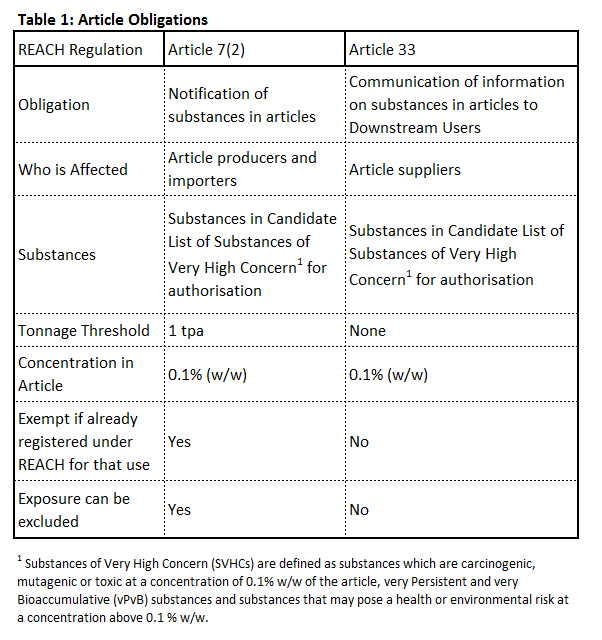
REACH Article 7(2)
Producers and importers of an article containing one of the substances on the Candidate List above 0.1% w/w must notify ECHA by submitting a notification. Notification is not required if the manufacturer can exclude exposure to people or the environment during use, or if the substance has already been registered under REACH for your particular use. Confirmation of this should be available from the Lead Registrant if you do not already know if your use is supported. Notification substantiation (or justification of notification exemption) should be readily available if asked to demonstrate compliance.
REACH Article 33
Suppliers must communicate the presence of any Candidate List substance above 0.1% w/w and information on safe use of the article to customers. Access to sales data is critical in order to notify all possible downstream users and provide enough information for the article to be used safely. At minimum, downstream users will need to be provided with the name of the Candidate List substance.
What needs to be done practically in order to comply?
Firstly, companies that operate throughout the supply chain must evaluate their infrastructure to ensure that they can support the collection and storage of Bill of Material data.
Large companies with extensive financial resources have likely made the infrastructure investment and are already tracking at a highly detailed level; they can identify articles under the new definition and are able to drill down to establish if there is a Candidate List substance present in the article at greater than 0.1% that would trigger notification. At stake are small and medium sized companies that are using tracking spreadsheets and may not have an IT system in place to efficiently manage the new obligations and the dedicated resources to run it.
Secondly, companies must now undertake an assessment of their Chemical Substance Inventories (CSI). Updating your CSI will require communication both up and down the supply chain. Data collection must be done to fill gaps where necessary and to ensure that all of the components of the new article defined by the new ruling and the exact composition are present within the CSI. Diligent maintenance of the CSI will serve companies well in the future as regulations change and emerge in all geographies. Presumably, companies should already have robust record keeping in place to meet overall REACH compliance.
Companies will need to ask themselves if they have a robust vetting process in place for parts and suppliers. Working together with your internal purchasing department, companies should have the freedom to de-select vendors who do not meet the new requirements and identify alternate suppliers. The source, reputation and the quality of information provided within the supply chain are increasingly becoming a factor in sourcing activities for companies and is key to overall regulatory compliance. Most suppliers take their obligations seriously and readily provide the required documentation. Some suppliers will need to be contacted by downstream users to keep data on composition and risk current. Even the most prepared companies will find this communication challenging.

Finally, when companies have identified which substances require notification to ECHA, they must undertake the notification process through the REACH-IT platform and record and file the confirmation numbers to demonstrate compliance. Some companies will have the resources to be able to do this comfortably on their own, and others may need to outsource this step.
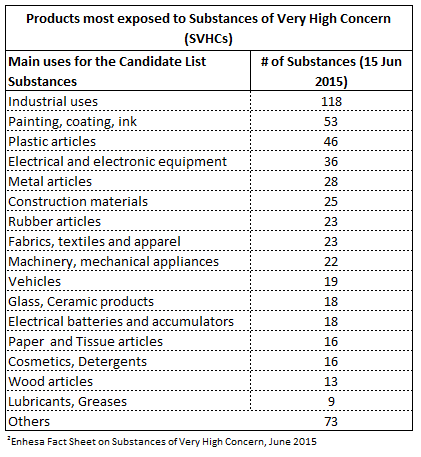
In order to narrow down whether or not your article may contain one of the currently 163 Candidate List substances, below is a very broad categorization by industry2.
For some companies it may not be possible to meet these obligations, and following a cost-benefit analysis, they may decide that changing product composition to a non-Candidate List substance will be easier and exempt them from these and further obligations, such as eventual authorization. Building an effective substitution strategy will be paramount to managing this approach.
There are many reasons for article manufacturers and importers to take action now regardless of the path they choose. Of course, there is the legal liability faced by companies that do not comply. Failure to comply may result in market loss as companies will no longer be permitted to import into the EU, providing your competitors that do comply with an advantage. NGO’s and consumer organizations could possibly highlight lack of compliance and make public allegations regarding your company that could damage your reputation. Increasingly, retailers are taking an interest in product composition, with some retailers banning the sale of products that contain select substances that are considered hazardous. Even consumers have an increased interest in what is in their products; the more consumers are informed about regulatory affairs, the more manufacturers and importers have to learn to deal with this new scrutiny and be prepared to address their concerns in a timely fashion.
Strong infrastructure, tracking systems, CSI knowledge, interdepartmental collaboration, robust preparation and excellent supply chain communication will be required of companies to meet the notification obligation of newly identified articles immediately. Further complications are expected to arise as ECHA revises its guidance documents and in December 2015, when additions to the Candidate List are expected (with more to follow).
We may now officially add “Once an article, always an article” to our REACH lexicon and rise to meet all of the challenges associated with the new obligation.