-1.png?width=175&height=47&name=anthesis-logo_living-coral%20(1)-1.png)
Wondering what circular principles, the construction industry and the Paralympics have in common? Claudia Amos explores the links here, and in timely honor of Recycle Week 2016 too.
‘Spirit in Motion’ – the Paralympic motto – is all about overcoming boundaries, changing perceptions, blowing expectations out of the water, and achieving great things against the odds. And the intensely inspirational ‘Spirit in Motion’ being shown by Paralympic athletes from all over the world is rousing us to apply this thinking across non-sporting challenges too – particularly to the circular economy and how it applies to the construction sector.
WHAT’S THE UNDERSTANDING AND AMBITION (GOLD STANDARD) FOR A CIRCULAR ECONOMY?
Circular economy business models engage stakeholders from a wide range of industries to stimulate supply chains that keep materials and resources at their highest utilization and value throughout their life cycles, and consider the market, environmental and social costs of goods and services. A circular economy supports the use of renewable resources; minimizes risks associated with finite raw materials; uses energy most efficiently in the production and delivery of goods and services; and preserves natural capital, including preventing negative impacts on water resources. The creation of an economy based on these principals also stimulates innovation and creates sustainable long term growth that supports the development of new employment opportunities and generates demand for new skills.
So, while neither of us can claim to know the ins and outs of what it takes to achieve Paralympic success, here’s our very own “Go for Gold Training Manual” for circularity in the construction sector…
1. Understand the climate you’re operating in
The construction industry is seen as a national infrastructure priority in the UK. According to the recent ‘Independent survey of attitudes to infrastructure in Great Britain’, the public’s two infrastructure priorities for the country are renewable energy (chosen by 43%) and building more homes (39%)[1].
In early 2016, Britain’s construction sector suffered a sharp slowdown, coinciding with signs the economy was losing momentum through uncertainty around the EU referendum. And the Office for National Statistics reported construction output – which accounts for about 6% of the economy – fell 3.6% in March 2016, the biggest drop for more than four years.[2] Despite this rocky start to 2016, construction output is actually now doing okay, recently being reported as ‘flat in July…’ with ‘…very little anecdotal evidence at present to suggest that the [Brexit] referendum has had an impact on output’. And the Financial Times reported on 12 September that there are ‘good August results in the 3 main purchasing manager surveys – for the services, manufacturing and construction sector.’[3]
Even in a difficult UK economic climate, you could say now is as good a time as any to get your head in the game…
2. Work out your method for success (hint: it’s circular!)
With an annual use of 400 million tons of resource and 120 million tons of waste generation[4], the construction industry is a unique sector for putting ‘Spirit in Motion’ and improving sustainability by introducing circular economy business models to increase efficiency and overall profitability to maintain competitive advantage and grow your business in a difficult economic environment. This heavily-regulated sector, with complex supply chains handling a wide variety of materials, has been leading the sustainability debate in a number of areas for years – i.e. carbon accounting, sustainable sourcing (including schemes such as FSC, PEFC, BES6001, Eco-Reinforcement etc.), driving transparency for material use, and providing third party evidence of responsible sourcing.
So the building blocks for success are already out there, it’s just about deciding how you’re going to apply them.
3. Know what your competitors are doing… and then do something better
All industries are aware that ‘end-of-pipe solutions’ are only going to work in the short term. Long term, the focus is going to be on shifting production models to produce less waste, and to maintain ownership of assets so that maximum value can be recovered.
There is a changing perception about renting vs ownership – shifting towards a lease/rent model, which helps manufacturers keep track of their products and increase circularity. The construction sector is no different, and has been implementing these concepts by forward integration into aggregate re-processing, topsoil upgrading, timber re-use and recycling, etc. However, after these ‘easy wins’, the concept of ‘ownership’ of other, potentially more valuable resources and ‘striving for gold’ needs a more systematic approach to enable construction companies to reduce wastage and reuse materials.
Most companies are focusing on increasing efficiency (e.g. manufacturing) but this is only ‘less bad’ not ‘more good’. The ‘gold medal’ will be awarded for completely changing the way we build – the design of all things needs to be dramatically changed to include circularity from a conceptual stage and incorporate material recovery into design and the functionality of construction products.
So what are you doing that will keep you as the front-runner all the way round the track?
4. Stick to your training program
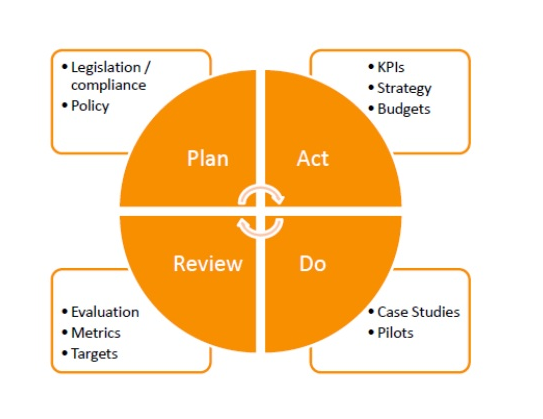
Many companies are at a loss for how to ‘do’ circular economy or even how to get started and understand the potential opportunities apart from the obvious ‘easy wins’. A tailored training program incorporating a structured and interactive approach is needed to embed good practice and change management over time following basic rules of ‘plan, act, do and review’. The training will also include more specific circularity tools, such as materiality assessments and circularity metrics to evaluate sustainability concerns and identify specific risks for construction businesses. Robust reporting mechanisms are key to a successful training regime to help both the company and its stakeholders to understand how environmental or social issues present risks, and where circularity opportunities can be identified.
5. Persevere – winning gold isn’t easy!
The area of concern for the construction industry is the wide range of materials used during construction, materials discarded during construction, as well as the materials discarded during refurbishments, and any other changes while the building is in operation. It is inherently difficult in this sector to estimate and forecast waste figures and end destination due to the time lag between material use and wastage. In a circular economy, business will need much closer links with their supply chain partners and a full understanding of their waste production and resource needs.
6. Seek your peers’ experience across all sectors
Information is being collected by waste management contractors, building trades, sub-contractors, as well as the principal contractor, to comply with a variety of internal and external standards. This includes duty of care, PAS 402, BES6001/BS8001, CE Markings (CEN350), EN15840, BREAM, CEEQUAL, LEED etc., or as part of their Life Cycle Assessment or own sustainability regimes. However, all this information is rarely collated and assessed to identify materiality risks, optimize material flow, and for effective decision making in waste reduction, recycling and recovery. This lack of visibility can result in financial penalties, reputational risks, reduced sustainability performance and lost CE opportunities.
So it’s important to put all your heads together, whatever your “sport”, and build on collective data.
7. There’s no time like the present
It’s time for the construction and civil engineering sector, including clients, developers, contractors and suppliers, to investigate structured approaches to the opportunities circular economy thinking provides – to make supply chains more sustainable and cost effective and put the ‘Spirit in Motion’ to go for gold.
If you’d like to discuss how Anthesis can support your organization with applying circular thinking to the construction sector, please get in touch with Claudia Amos or use our fill out form below.