-1.png?width=175&height=47&name=anthesis-logo_living-coral%20(1)-1.png)
Anthesis' CTO Craig Simmons shares some thoughts on Tesco's new FareShare scheme
Currently being piloted in ten UK stores, the scheme has already proven successful in Ireland where it is operating in more than 100 outlets.
Essentially, it works like this. Store managers use the FoodCloud smartphone app or website to flag up when they have unwanted, edible ‘in date’ food that would otherwise be thrown away. This information is broadcast to registered local charities who turn up and collect it. Simple.
The only problem is that supermarkets are responsible for only a small fraction (about 1%) of food waste. As work by WRAP has shown, most of the 15m tonnes of UK food waste arises upstream or downstream of the retailers, for example, as a result of agricultural losses or in the home. The infographic below, produced for Tesco by Anthesis, shows the waste arising from typical bagged salad products. A staggering 60% is wasted – but only 1% of that is in-store.
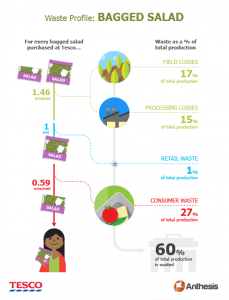
To really take a bite out of the UK’s food waste, the Tesco/FareShare scheme needs to be adapted for use by producers and consumers. Of course, this needs to sit alongside measures to minimise waste in the first instance.
Next week I am off to an annual meeting of the Cool Farm Alliance (CFA), whose award-winning Cool Farm Tool is very much aimed at improving the resource efficiency, and consequently reducing the waste arising from, agricultural production. It is perhaps no coincidence that Tesco is a leading member, alongside other retailers and brands, of the CFA.
In terms of consumer waste, the ‘Love Food – Hate Waste’ campaign continues to raise awareness about the financial and environmental cost of throwing away up to a third of what is bought.
We are seeing a coming together of initiatives to reduce food waste along the supply chain from farm to fork. That can only be a good thing.